Ackerman and Saumur
A Pioneering House
Vous êtes ici : Accueil » The World of Ackerman » Our history

The Ackerman Epic
The modest Brussels couple who welcomed young Jean-Baptiste on June 24, 1790 could not have imagined that they were giving birth to a talented entrepreneur. Born to grandparents who were farmers, it is therefore no coincidence that, a little after his twentieth birthday, around 1811, following numerous travels, the young man settled in France in the rich Saumur terroir. The choice of Saumur was first and foremost dictated by favorable geological conditions: the chalky soils dominated by tufa stone naturally lend themselves to sparkling wine; but it was also the confluence of many other advantages, such as the presence of waterways facilitating transport, convenient links with Touraine ensuring a supply of wines, and a readily available workforce.
In 1811, at just 21 years old, Jean-Baptiste Ackerman founded the House that still bears his name today. Within a few years, he developed a thriving wine trade. Having become an influential figure, always at the forefront of progress, this self-made man, aware of the importance of transport, even contributed in 1840 to the development of the railway in western France: by 1849, the Paris–Saumur line was inaugurated. Even if the journey to Paris took ten hours, the map of France at the time highlights Saumur’s early adoption of the railway, making it one of the few towns served by 1850.
After several years of trading still wines and deepening his knowledge of Loire Valley grape varieties and terroirs, he set himself a new challenge: to produce fine sparkling wines from the grapes of the Saumur region.
The “Champenoise Method”
Jean-Baptiste worked tirelessly to develop a method that harnessed the Saumur wines’ natural ability to become effervescent: his renowned méthode traditionnelle. In 1838, the Tasting Commission at the Angers exhibition recognised him as the first producer capable of applying the traditional method in the Loire Valley, awarding him a gold medal, the first of many to come. This rivalry with the established Champenoise method in Champagne led to a lengthy legal battle that continued even after his death on January 10, 1866. To this day, as a legacy of this long struggle, Saumur wines must describe their bubbles on their labels not as “méthode champenoise” but as “méthode traditionnelle.”
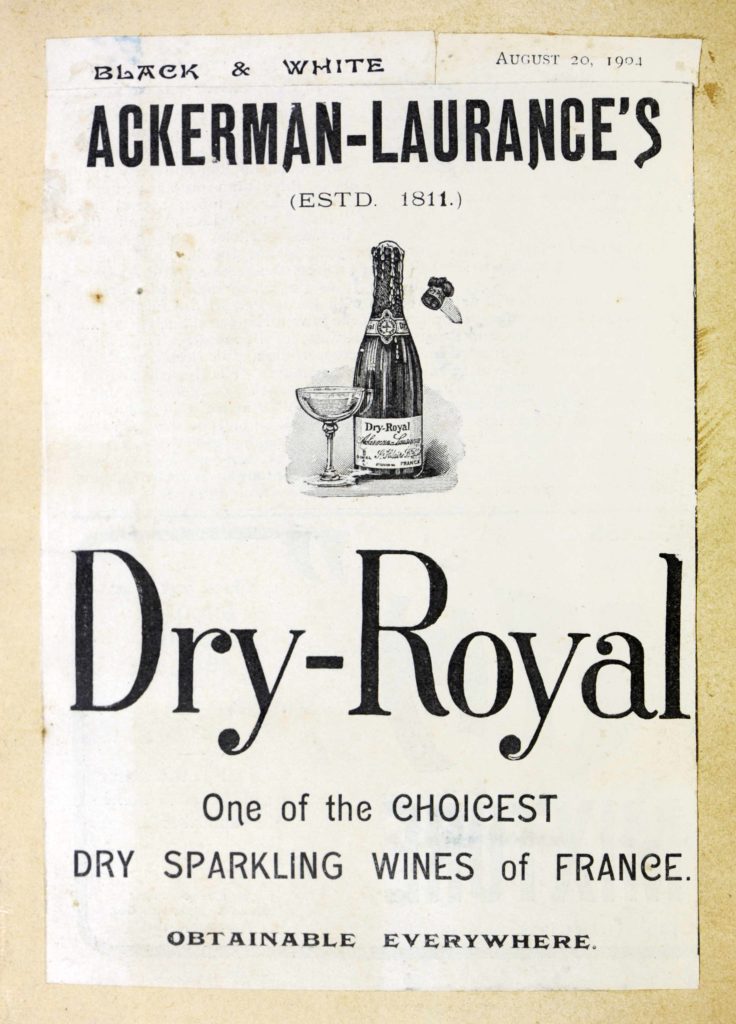
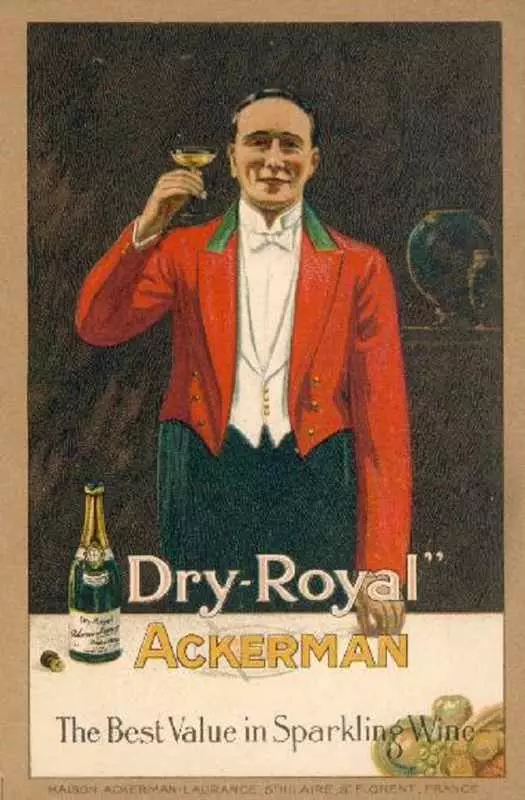
An innovator in every sense, in 1863 he registered with the Saumur court a cork on which he had the idea to imprint his House’s name. Fully modern, he also embraced advertising with great enthusiasm: photographs, posters proclaiming, “No joyful hunting dinner without Ackerman-Laurance Dry-Royal.”
A Heritage Inherited, Troglodyte Cellars
In 1840, Jean Baptiste acquired troglodyte cellars along the banks of the Thouet, a river flowing into the Loire, France’s longest river and, at the time, the main route for transporting goods. These cellars became a symbol of Maison Ackerman’s deep roots in a terroir unique in France and the world, dotted with castles and vineyards, and recognised by UNESCO, which inscribed it on the World Heritage List.
The cellars are ideal for storing and producing its “sparkling” wines: consistently cool temperatures, perfect humidity, low light, and vast storage capacity. Under Jean Baptiste Ackerman, the troglodyte cellars found a second life, becoming the production and commercial hub typical of Loire Valley fine sparkling wines. From the mid-19th century onwards, sparkling wine houses proliferated, establishing themselves on either side of the Ackerman cellars.
These cellars were at the heart of a new economic activity and operated as true workshops, where men and women, with their unique expertise and by candlelight, racked, turned, disgorged, capped, and labelled bottles of fine sparkling wines destined for export worldwide.
Today, the cellars bear witness to the daily activity of the winehouse workers up until the mid-20th century. They remain a prominent feature in the natural and industrial landscape of Saumurois and constitute a unique heritage along France’s longest river, the Loire, listed as a UNESCO World Heritage site.
While the Maison Ackerman cellars are no longer used for wine production, they remain the soul of the House. As places of memory and history to be discovered, the cellars also serve as a space for conviviality, hosting contemporary artists in residence, events and performances, as well as a tasting cellar where visitors can enjoy the full range of Maison Ackerman fine sparkling wines.
A multi-sensory journey into the heart of the cellars.
Conquering the World!
Jean Baptiste Ackerman achieved the remarkable feat of turning his flagship label, <em>Royal</em>, into a brand recognised across the globe. Ackerman fine sparkling wines soon graced the tables of the world’s most prestigious establishments.
His son, Louis-Ferdinand, who took the reins of the House in the late 1860s, continued his father’s mission, leveraging the rapid growth of global trade to elevate the Maison bearing his name to even greater heights. From the 1870s through the 1910s, Maison Ackerman experienced a meteoric rise.
Thanks to Jean Baptiste, his son inherited and expanded a carefully woven network of loyal clients and brand ambassadors. As a result, Maison Ackerman wines earned a level of recognition that has never been diminished.
Being Seen: A Crucial Challenge
The Loire Valley’s First Fine Sparkling Wine House
Maison Ackerman is the heir to Maison Ackerman-Laurance, founded in 1811 by Jean Baptiste Ackerman and Jean Pierre Apollinaire Laurance-Olivier, a skilled grain and wine merchant in Saumur.
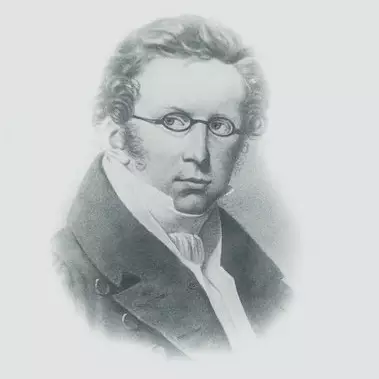
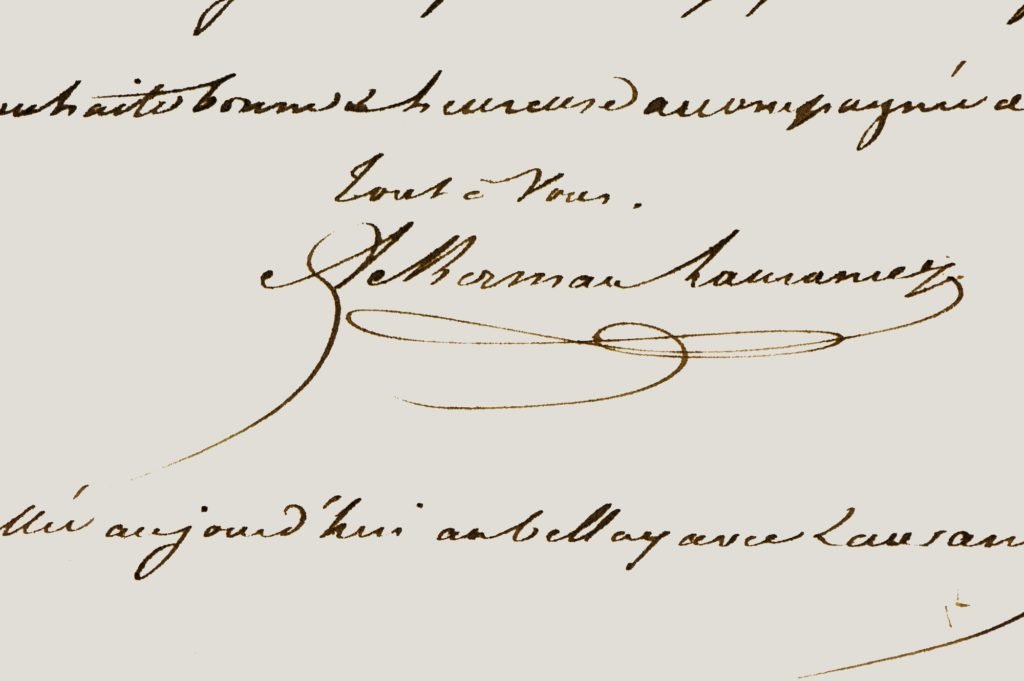
The signature of Jean Baptiste Ackerman, the “Champagne-style” wines of Saumur!
Jean Baptiste Ackerman recognized in the wines of Tours and Saumur the potential to produce “Champagne-style” wines. The wines naturally “fizz.” In 1831, he experimented with the champagnisation of wines using white Loire Valley grape varieties and perfected the traditional method. By 1834, he marketed his first bottles, numbering only a few hundred.
In 1838, he presented his 1836 vintage at the Angers Industrial Exhibition. Following careful examinations and oenological analyses, the jury awarded him a gold medal: this marked the beginning of Jean Baptiste Ackerman’s fine sparkling wine journey and gave a new identity to the town of Saumur.
“Maison Ackerman showcases its creations of Loire Valley fine sparkling wines at exhibitions, fairs, and both amateur and professional competitions around the world, always returning with its arms full of medals! This is the recognition of two centuries of expertise and the well-deserved reward for the continuous innovations of our teams.” Séverine Lepaul, Oenologist and Production Director, responsible for the vineyard, winemaking, and bottling.
The pursuit of Ackerman-Laurance wines: a modern industrial and commercial adventure
The Industrialisation of Fine Sparkling Wines: a Made-in-Ackerman-Laurance Development
In 1840, Jean Baptiste Ackerman acquired “troglodyte” cellars in Saint-Hilaire Saint-Florent, on the banks of the Thouet, where the small river meets the Loire. These cellars were ideal for storing and producing his “mousse” wines: cool, constant temperatures, low light, and large storage capacity. Under Jean Baptiste Ackerman, the troglodyte cellars found a second life, becoming the typical production and commercial hub for Loire Valley fine sparkling wines. By the mid-19th century, sparkling wine houses multiplied and settled on both sides of the Ackerman-Laurance cellars. These cellars became the heart of a new economic activity and true manufactories, where men and women—armed with unique expertise and working by candlelight—racked, turned, disgorged, muscled, and labeled the fine sparkling wine bottles that would be exported worldwide. Today, the cellars bear witness to the daily activity of the winehouse workers up until the mid-20th century. They remain a prominent feature in the natural and industrial landscape of Saumur, representing a unique heritage on the banks of France’s longest river, the Loire, a UNESCO World Heritage site.
The Cellars of Maison Ackerman are no longer used for wine production, yet they remain the soul of the House. Places of memory and history to explore, they also serve as the aging site for our Royal cuvée. The cellars are a space of conviviality, hosting a contemporary artist residency, events and performances, and a tasting cellar where you can discover the full spectrum of Maison Ackerman fine sparkling wines. Experience a journey full of sensations, emotions, and memories.
Maison Ackerman-Laurance Conquering the World
In the 1850s, after several years of perseverance, Maison Ackerman-Laurance was no longer a small trading business. It had become the leading sparkling wine House of the Loire Valley.
Jean Baptiste Ackerman brought his son, Louis Ferdinand, into the family business. Together, they directed the production and commercialisation of fine sparkling wines towards England, creating a legendary brand: Royal. The brand, available as Brut Royal and Dry Royal, met with immense success on the island and throughout its empire, soon appearing on the finest tables around the world, from Europe to the Americas.
In 1863, Jean Baptiste handed over the reins of Maison Ackerman-Laurance to Louis Ferdinand, exhausted after a lifetime devoted to his dream. By 1866, Louis Ferdinand was solely at the head of an industry in full expansion.
He seized the opportunities of global trade to grow the business and make the name and wines of Maison Ackerman-Laurance known everywhere. He competed with Champagne houses, launching an innovative and fierce advertising campaign. He multiplied brand creations and established a strong network of ambassadors and loyal customers. This was the golden age of Maison Ackerman-Laurance.
“Advertising remains at the heart of our activity, and we continue to innovate every day to present our creations with an elegant and surprising profile, just like our bubbles.”
A Company Modernising at the Dawn of the 20th Century
In 1894, Maison Ackerman-Laurance became a joint-stock company with a capital of 3 million francs—a considerable fortune! Louis Ferdinand remained at the helm, supported by a close advisor, Raymond de Luze, and his son-in-law, Charles Elie de Laulanié. In 1901, the company opened a shop in Paris, then a global city. In 1911, the company celebrated its centenary in London during the Wine Trade Benevolent Society Congress. Maison Ackerman-Laurance was now at the heart of the two most important cultural, economic, and commercial capitals in the world. The dream of founder Jean Baptiste Ackerman had become reality on the eve of the First World War.
Maison Ackerman is a historic wine House, a pioneer of the fine sparkling wine industry in the Loire Valley, and the guardian of an exceptional heritage. But it is also a 21st-century company, forward-looking and innovative. Maison Ackerman never forgets its Saumur roots and the vital elements that have sustained its longevity and prosperity: its winegrowers, its employees, and its customers.